


Deborah Amos
Deborah Amos covers the Middle East for NPR News. Her reports can be heard on NPR's award-winning Morning Edition, All Things Considered, and Weekend Edition.
In 2009, Amos won the Edward Weintal Prize for Diplomatic Reporting from Georgetown University and in 2010 was awarded the Edward R. Murrow Lifetime Achievement Award by Washington State University. Amos was part of a team of reporters who won a 2004 Alfred I. duPont-Columbia University Award for coverage of Iraq. A Nieman Fellow at Harvard University in 1991-1992, Amos returned to Harvard in 2010 as a Shorenstein Fellow at the Kennedy School.
In 2003, Amos returned to NPR after a decade in television news, including ABC's Nightline and World News Tonight, and the PBS programs NOW with Bill Moyers and Frontline.
When Amos first came to NPR in 1977, she worked first as a director and then a producer for Weekend All Things Considered until 1979. For the next six years, she worked on radio documentaries, which won her several significant honors. In 1982, Amos received the Prix Italia, the Ohio State Award, and a DuPont-Columbia Award for "Father Cares: The Last of Jonestown," and in 1984 she received a Robert F. Kennedy Journalism Award for "Refugees."
From 1985 until 1993, Amos spend most of her time at NPR reporting overseas, including as the London Bureau Chief and as an NPR foreign correspondent based in Amman, Jordan. During that time, Amos won several awards, including a duPont-Columbia Award and a Breakthru Award, and widespread recognition for her coverage of the Gulf War in 1991.
A member of the Council on Foreign Relations, Amos is also the author of Eclipse of the Sunnis: Power, Exile, and Upheaval in the Middle East (Public Affairs, 2010) and Lines in the Sand: Desert Storm and the Remaking of the Arab World (Simon and Schuster, 1992).
Amos is a Ferris Professor at Princeton, where she teaches journalism during the fall term.
Amos began her career after receiving a degree in broadcasting from the University of Florida at Gainesville.
-
A team at Yale University is using open-source materials to document the forced removal of Ukrainian children to Russia. Russia says it's a vast humanitarian program.
-
 The world's first criminal trial on torture in Syria's prisons ended Thursday in Koblenz, Germany — the first time a high-ranking ex-Syrian official faced Syrians in open court in a war crimes case.
 -
 Kevin Dawes describes how a fellow prisoner in Syria kept a promise that called attention to Dawes' detention. Now, five years after his release, Dawes is suing the Syrian regime.
 -
 Witnesses have detailed Syrian prison abuse in a crimes against humanity trial in Germany for over a year. Some withdrew over threats, while many have persevered to bring to justice an ex-official.
 -
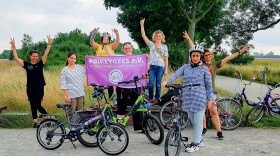 They come from countries where the idea of a girl on a bicycle is often taboo. Now a group called Bikeygees is teaching them to master the pedals. For the new riders, it's a lifelong dream come true.
 -
 An Israeli demolition last month revived fears among residents of al-Bustan in east Jerusalem's Silwan neighborhood. "Yes, Bustan is going to be demolished for a park," says Jerusalem's deputy mayor.
 -
 In the village of Jisr al-Zarqa, residents wish for opportunities available in nearby Jewish towns. They wonder if the new government, which includes an Arab party for the first time, will help.
 -
 The Israel Defense Forces said its fighter jets struck two Hamas military compounds early Wednesday morning.
 -
Israeli nationalists marched through Palestinian neighborhoods of Jerusalem Tuesday, heightening tensions and providing a first test for the new Israeli government.
-
Refugee advocates have welcomed President Biden's decision to raise the U.S. refugee cap from 15,000 to 62,500 this year. Community-based resettlement efforts are expected to become more prominent.


